
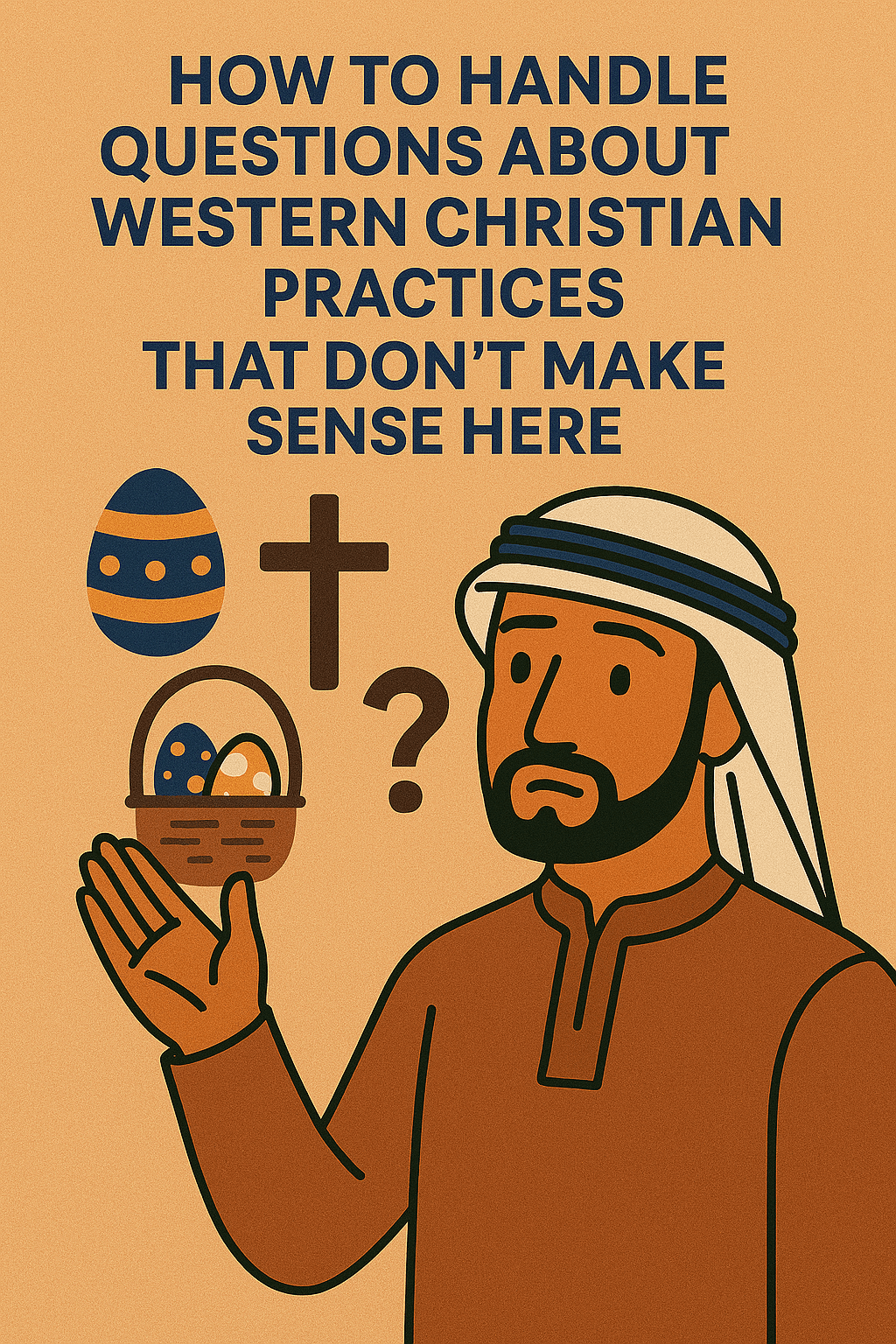
During one of our discipleship meeting, a young man asked this with all sincerity, ““Why do Christians in the West celebrate Easter with bunnies?” He was genuinely confused. He had read the Gospels, fasted with us during Holy Week, and participated in a simple sunrise gathering. But the colored eggs and chocolate rabbits he saw online left him baffled.
This is just one of dozens of questions we field weekly in our context.
Why do some Christians drink alcohol and others call it sin?
Why do churches in America split so easily?
Why are sermons timed like TED Talks?
Why do Christians pray with their eyes closed and hands in the air?
Why are worship songs so emotional and repetitive?
To many of us raised in the Middle East, these practices often seem foreign, inconsistent, or even nonsensical especially when presented as normative for Christian life.
As Arab believers, we find ourselves in the tension between the Western missionary influence that helped birth many of our churches, and the cultural worldview of our own people. When those two worlds clash, questions are inevitable. And when our Western brothers and sisters are present in the conversation, how they respond is everything.
The Missed Opportunity
In our honor-shame cultures, questions aren’t just for understanding. They are a test of your character, humility, and trustworthiness. A question is rarely just intellectual; it’s relational. When someone asks about something strange in Western Christianity, they are not just looking for a theological explanation. They are testing:
- Can I trust this person to be honest?
- Do they understand our world?
- Will they look down on us for asking?
- Is their version of Jesus for me too—or just for the West?
If you respond with offense, dismissal, or defensiveness, you may win an argument but lose a disciple. But if you respond with humility, context, and clarity, you can build a bridge to Jesus.
The Pastor’s Wife and the Bikini
One summer, a missionary couple hosted a women’s retreat at a beach resort. During free time, the missionary’s wife changed into a bikini and went for a swim. The local Arab women, many of them came after the Syrian war, froze in shock. Later, Salma (who is a worker with us) overheard whispers: “If this is what Christian freedom looks like, is this what Jesus taught?”
No sermon was preached. But a message was received.
This moment became a flashpoint. Salma had to walk with these women through their confusion, separating cultural expressions of freedom from biblical definitions of holiness. She explained that for some Western Christians, modesty looks different. She also made clear that the gospel is not bound to one culture’s norms.
What mattered more than the bikini was how we responded to the questions it provoked.
4 Principles for Western Missionaries When the Questions Come
1. Don’t Defend Culture—Disciple Through It
Western practices aren’t sacred. Some are rooted in Scripture, others in tradition, others in modern convenience. Don’t be quick to defend everything. Instead, ask: “Does this practice reflect the heart of Christ in this context?”
2. Use Curiosity as a Discipleship Moment
When someone asks, “Why do Western Christians do that?” don’t shut it down. Lean in. Say, “That’s a great question. Let’s explore together what Scripture says and how different cultures have understood it.”
3. Clarify the Gospel at Every Turn
Many Western practices are not part of the gospel, but people here often assume they are. Separate the eternal truth from the cultural wrapping. This is not compromise—it’s precision.
4. Model Humility, Not Superiority
Admit when something doesn’t translate well. Be honest when a Western practice clashes with local values. Humility earns respect. Superiority kills trust.
Final Thought: We’re Not Asking You to Be Arab
We don’t need you to become like us. We need you to become more like Christ among us. That means being a student of culture, a bridge-builder, and a bearer of good news in forms we can grasp.
 The Basin and Towel