
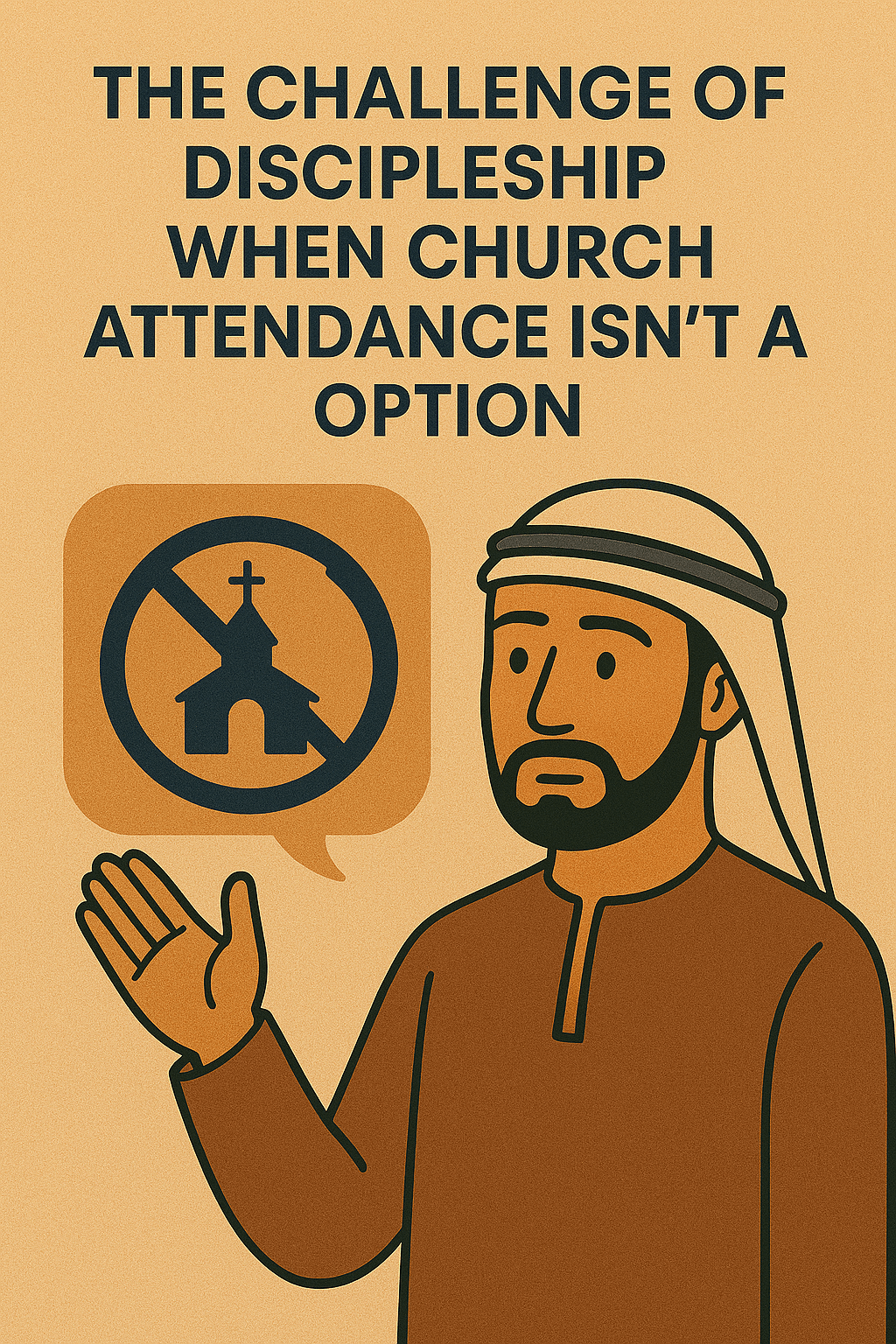
When Western friends hear that church attendance is not an option for many believers in the Middle East, they often respond with genuine concern and confusion. “But how can they grow?” they ask. “How do you make disciples without a church?”
It’s a fair question—but perhaps it also reveals how deeply we’ve equated “church” with a building, a weekly service, or even a formal pastor-led gathering. In many of our contexts, those elements don’t exist—or if they do, they come at great personal risk.
Discipleship here doesn’t happen in pews. It happens in kitchens, taxis, WhatsApp calls, and quiet walks after dark.
The Myth of the Sunday Model
In the West, the rhythm of discipleship often revolves around Sunday: teaching, worship, sacraments, and community. It’s structured, predictable, and protected by law. But what if that rhythm is illegal? Or surveilled? Or simply out of reach because gathering would mean losing your job, your home, or your life?
For many MENA believers—especially first-generation ones—gathering openly is impossible. The Sunday model crumbles under the weight of real-world risk. And so we adapt, not by lowering our commitment, but by reimagining what spiritual formation looks like.
We become disciples in exile, forging new ways of being Church in the cracks of hostile soil.
A Story from the Ground
I think of “Rami,” a young man from a conservative Muslim background who came to faith after a dream of Jesus and months of secret study. He cannot go to a church—there are none in his town. The closest house church is a two-hour drive away, and it meets irregularly due to security issues.
So, how does Rami grow?
Every Tuesday, he meets with an older believer at a coffee shop. They read Scripture aloud—quietly, discreetly—asking, “What is Jesus saying? What will I obey this week?” They pray under their breath. Rami listens to audio Bible chapters on his walk to work. He memorizes Psalms while waiting in line at the bakery. He texts me his thoughts on Matthew, and I reply with voice notes about the parables.
He has never stepped inside a church building. Yet, he is becoming a disciple. His life is being shaped by Christ—bit by bit, from the inside out.
Redefining Success
In Western missiology, we’ve often measured success by attendance and activities. But in places like ours, those metrics are not only impractical—they are unfaithful to the reality on the ground.
Discipleship here is more organic than organized, more relational than ritualized.
It’s not a program. It’s presence. It’s incarnation.
If Jesus discipled in boats, on hillsides, and around fires, then why should we assume pews and pulpits are the only valid forms?
The Real Challenge
The real challenge of discipleship in our region isn’t lack of hunger. It’s the loneliness of obedience.
When a believer can’t publicly gather, they often feel like they’re the only one. Isolation gnaws at the soul. They need more than teaching—they need companionship, spiritual family, and the assurance that they’re not walking alone.
This is where Western partners can lean in: not to export a system, but to walk alongside us as co-disciples. To support the formation of believers in ways that are contextual, creative, and courageous.
A Final Word to the Western Church
If you take anything away, let it be this: Church is not a place we go—it’s a people we become.
Don’t mourn the absence of buildings here. Celebrate the presence of Christ in kitchens, courtyards, and encrypted calls.
We don’t need cathedrals to make disciples. We need conviction, community, and the creativity of the Spirit.
So when church attendance isn’t an option, discipleship isn’t paused.
It becomes more real than ever.
 The Basin and Towel