“Why hasn’t he been baptized yet?”
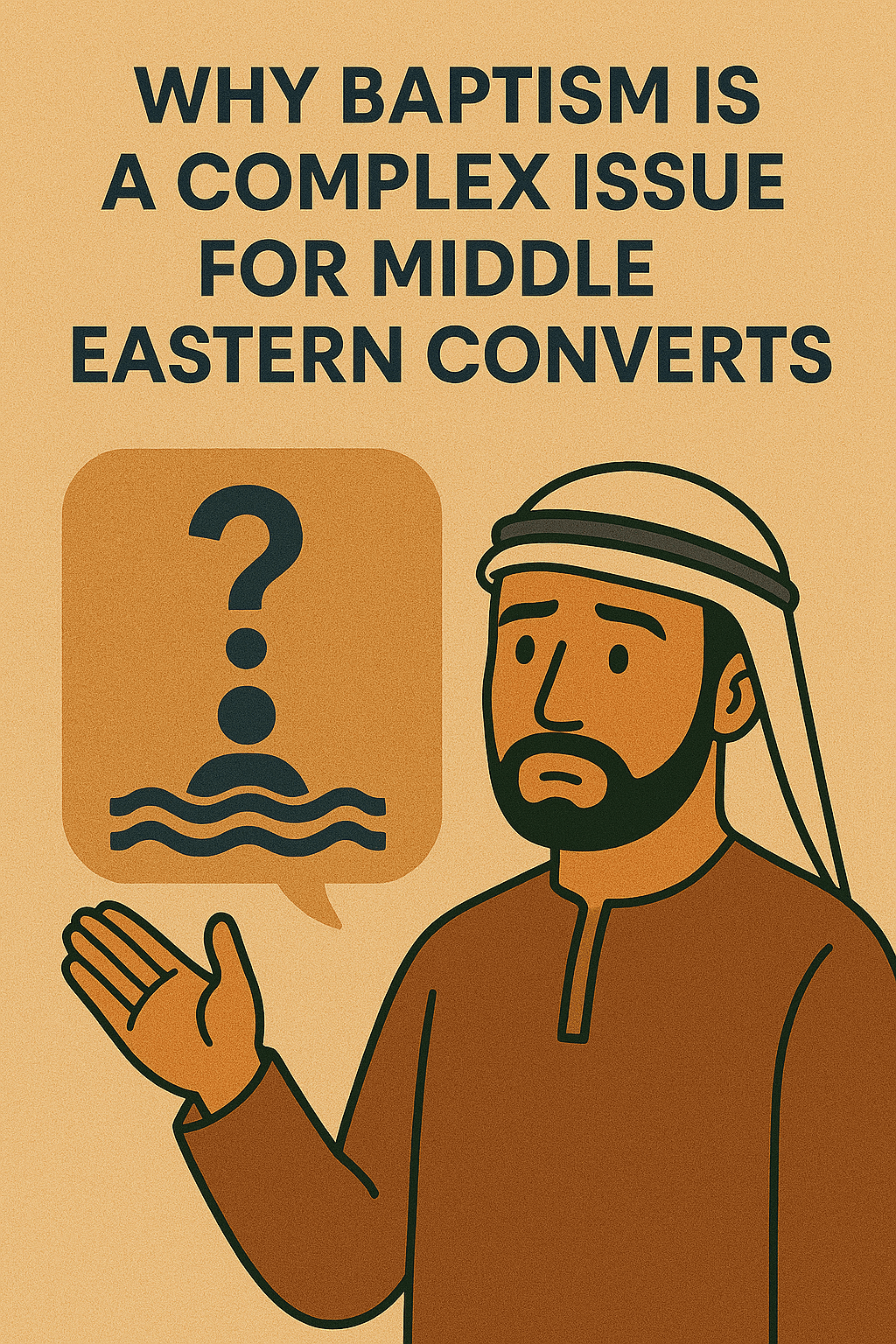
That was the question a well-meaning visiting pastor from the West asked me over lunch one day.
I smiled. Then I sighed.
“Because his father will kill him.”
A Simple Act That Changes Everything
In the West, baptism is celebrated with smiles, family photos, and maybe a post-service brunch. But here in the Middle East, it’s a funeral of sorts. Not because it symbolizes death to sin—though it certainly does—but because, in many cases, it marks the beginning of persecution, exile, or worse.
For many Muslim-background believers, baptism is not just an outward expression of inward faith. It is proof to their family, their tribe, and their community that they have irrevocably left Islam. It’s a declaration that cannot be undone.
In many Islamic cultures, a person can talk about Jesus, read the Injil, or even pray in His name so long as they haven’t formally left Islam. But once they are baptized, it’s over. They are seen as apostates. Shame descends on the family. And sometimes, so does violence.
The Story of Samir
Let me introduce you to Samir, a young man from a conservative Sunni background in the Levant. Samir came to faith after years of secret searching, dreams, and late-night YouTube videos by Brother Rachid. He joined our house fellowship quietly. He devoured Scripture. His joy was real.
After six months, he asked about baptism.
But here’s what you need to understand: Samir still lived at home. He worked at his uncle’s shop. His entire social structure was Muslim. If he were baptized and his family found out, he could lose his home, his income, and possibly his life.
We met and prayed. I told him, “The question is not, ‘Should you be baptized?’ The question is, ‘Are you ready for the consequences?’”
It was another year before Samir was baptized, in the pool of hotel far in mountains. No pictures. No songs. Just trembling hands and whispered prayers. Afterward, he wept. He had counted the cost, and he had chosen Christ.
He now lives in another city. His family disowned him. But his faith is stronger than ever.
Why the Western Model Doesn’t Fit
There’s a tendency among some Western ministries to rush baptism, as if it is the main proof of salvation. I understand the theological concern. But without understanding the cultural context, you’re asking converts to take a step that could get them killed, sometimes prematurely.
We must not measure obedience by the same timelines used in suburban churches. In many cases, delayed baptism does not reflect disobedience, but sober preparation. Yet it must always be seen as a necessary step of obedience. Every believer must eventually obey Christ’s command, even when the cost is great. The cross is not optional.
Our goal is not to avoid baptism but to prepare disciples who can endure what baptism brings. We are not lowering the bar; we are helping them rise to meet it.
What Baptism Means Here
- It severs ties – Often, permanently. Family, inheritance, marriage prospects, and identity are lost.
- It invites suspicion – Government surveillance, community rejection, even legal consequences.
- It requires witness – Someone must testify to their faith journey, which can also put others at risk.
And yet…
- It strengthens the soul – Baptized believers, even when persecuted, often walk with a clarity and courage few others possess.
- It ignites courage in others – When one takes the plunge, others begin to consider the cost for themselves.
- It aligns them with the suffering Church – They understand the fellowship of Christ’s sufferings in a real and powerful way.
How You Can Help
- Listen before you lead – Ask local believers about the risks and rhythms of faith where they are.
- Partner, don’t pressure – Walk with converts in discipleship, helping them count the cost with wisdom, not haste.
- Support long-term care – Many baptized believers lose everything. Consider how your church can help fund housing, work, or relocation if needed.
- Pray for courage – Not just for converts, but for us as leaders too. Walking someone to the baptismal waters here is often like walking them to a cross.
A Kingdom Declaration, Not a Cultural Flashpoint
Jesus said, “If anyone would come after me, let him deny himself, take up his cross, and follow me” (Luke 9:23). Baptism, in our region, often is that cross. It is the public declaration that we now belong to another Kingdom. But we cannot follow Jesus in secret forever. In time, faith must go public.
So when you ask, “Why hasn’t he been baptized yet?”
Please, ask a second question: “Am I ready to walk with him when he is?”
And never forget to ask the most important question: “Are we leading them toward obedience to Christ in every area—including baptism?”
Final Thought
In the end, baptism is not merely a cultural flashpoint—it is a kingdom proclamation. Wherever it takes place, in a bathtub or a river, with tears or with joy, it is the sign that the old has gone and the new has come. We do not baptize lightly—but we also do not shrink back. For we serve a King who calls us to die, that we might truly live.
 The Basin and Towel