In the dry wadis of southern Jordan, water is life. No one builds grand fountains in the desert. They dig discreet wells, tucked in rocky shadows, protected by the trust of the few who know its location. In a land where exposure invites danger, wisdom chooses hidden strength. The Church in our region is like that—those who survive and thrive don’t gather in cathedrals. They gather at wells.
The Myth of Size: What the West Gets Wrong
Let’s be honest. In much of the West, “church” means a building, a brand, and a Sunday experience. Success is measured by attendance, programs, and budget lines. But in the Middle East, those metrics are not only irrelevant—they’re dangerous.
Here, visibility can cost you everything. A convert from Islam who attends a public church may be photographed, reported, or worse. Families disown. Governments monitor. Extremists retaliate. And yet, Western partners sometimes pressure us to replicate that model—larger gatherings, formal leadership structures, public declarations. But these do not reflect how Jesus discipled, nor how the early Church multiplied under Roman persecution.
We don’t need stages. We need shelters. Small, trusted groups are the living wells of the Middle Eastern Church.
Trust is the Currency of the Kingdom
In the Gospels, Jesus didn’t start with the crowd. He started with Peter, James, and John. Trust was the foundation. In places where trust has been broken—by colonialism, by corruption, by religious oppression—it must be rebuilt slowly, one relationship at a time.
In our context, a group of 3–5 believers, deeply known and mutually committed, is more spiritually potent than a gathering of 300 strangers. Why?
Because trust is not scalable.
You cannot mass-produce discipleship. In our experience, real transformation happens when believers walk in confession, share meals, and carry one another’s burdens. Not in rows of chairs, but in circles of vulnerability.
The House in Aleppo
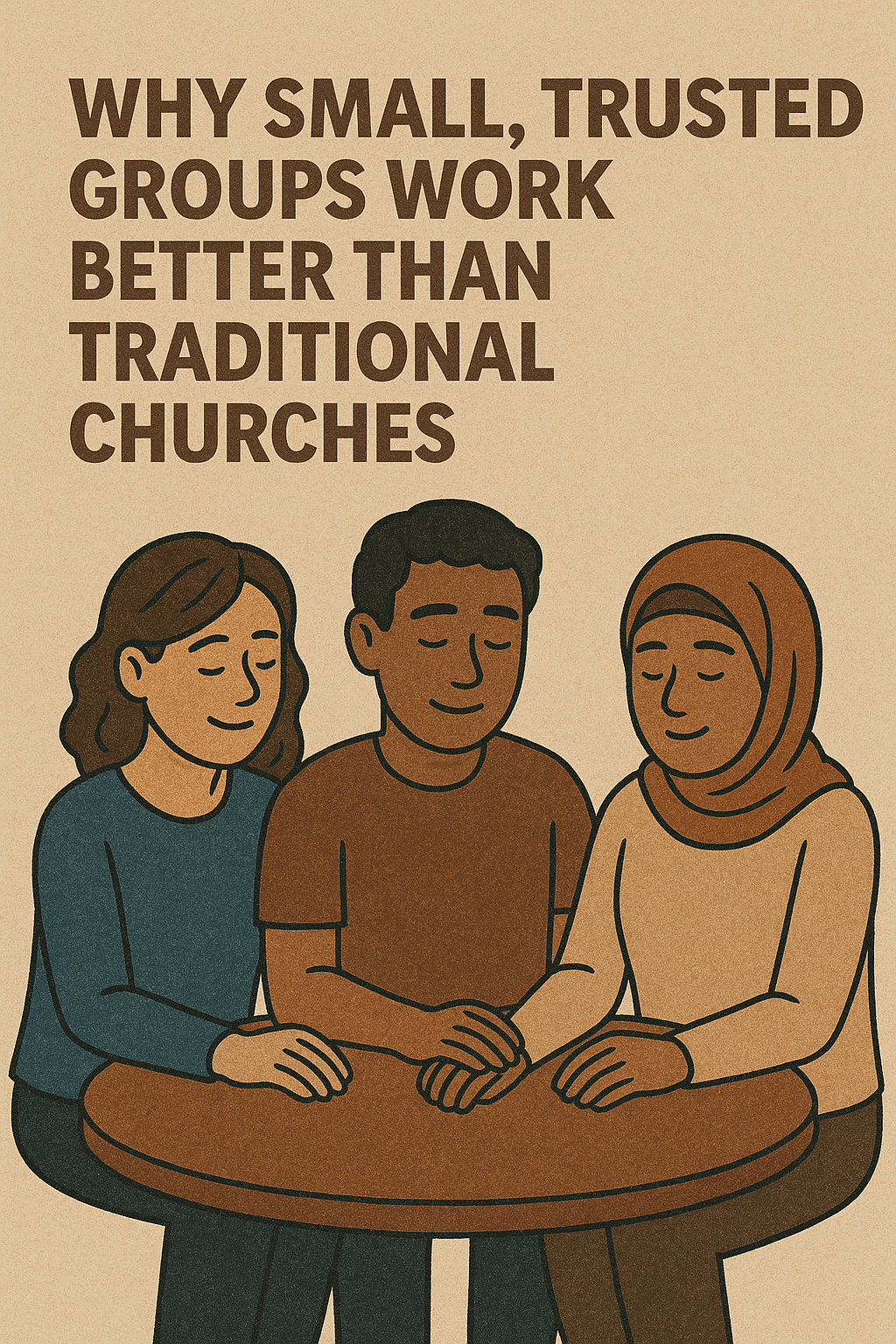
Three years ago, I met a young man in Aleppo—let’s call him Fadi. He had come to faith through dreams and a satellite TV broadcast. He dared not attend the local traditional church—he’d seen too many informants slip through the pews. Instead, he met weekly with two others in the back of a barber shop. They read Scripture aloud over the buzzing of clippers. They prayed with eyes open, pretending to talk business if anyone walked in.
That group baptized five others within the year—quietly, without a single flyer, video, or microphone. Today, there are twelve such gatherings across the city, each connected by trust, not logos. This is the underground river of the Church in hostile soil.
Less Structure, More Spirit
Western forms often bring with them a need for structure—constitutions, titles, meeting minutes. But in Scripture, the Spirit moves more organically. The early Church met in homes, not because they were poor planners, but because homes were where life happened. Meals. Tears. Laughter. Lament.
Small, trusted groups reclaim that ancient rhythm.
Yes, accountability matters. Yes, training matters. But when these are infused into the fabric of daily relationships, rather than isolated programs, they bear fruit that lasts. Our groups don’t need pulpits; they need presence. They don’t need preachers; they need priests—ordinary believers mediating the presence of Christ to one another.
What This Means for us?
If you’re reading this from the safety of your home, you might wonder: What does this have to do with us?
Everything.
Because the winds are shifting. Cultural hostility is rising. And beyond that—discipleship is being reclaimed from the crowd and returned to the few.
What we are learning under pressure may be a prophetic word for the Western Church: shrink to grow. Go smaller, go deeper, go slower. Trust the yeast. Invest in twos and threes, not the masses. Create wells, not fountains.
Jesus said, “I will build My Church, and the gates of Hades will not overcome it.” But He didn’t say He’d build it in ways that make us comfortable. He builds with people who know each other’s real names, real stories, real fears. In our region, we’ve seen this firsthand. The Kingdom grows not in the spotlight but in the shadows—like a well in the wadi.
If you want to help us, don’t ask for numbers. Ask for names. Ask how you can pray for a barber shop in Aleppo, a kitchen table in Baghdad, a shepherd’s hut in the Bekaa Valley.
Because that’s where the Church is truly alive.
 The Basin and Towel