
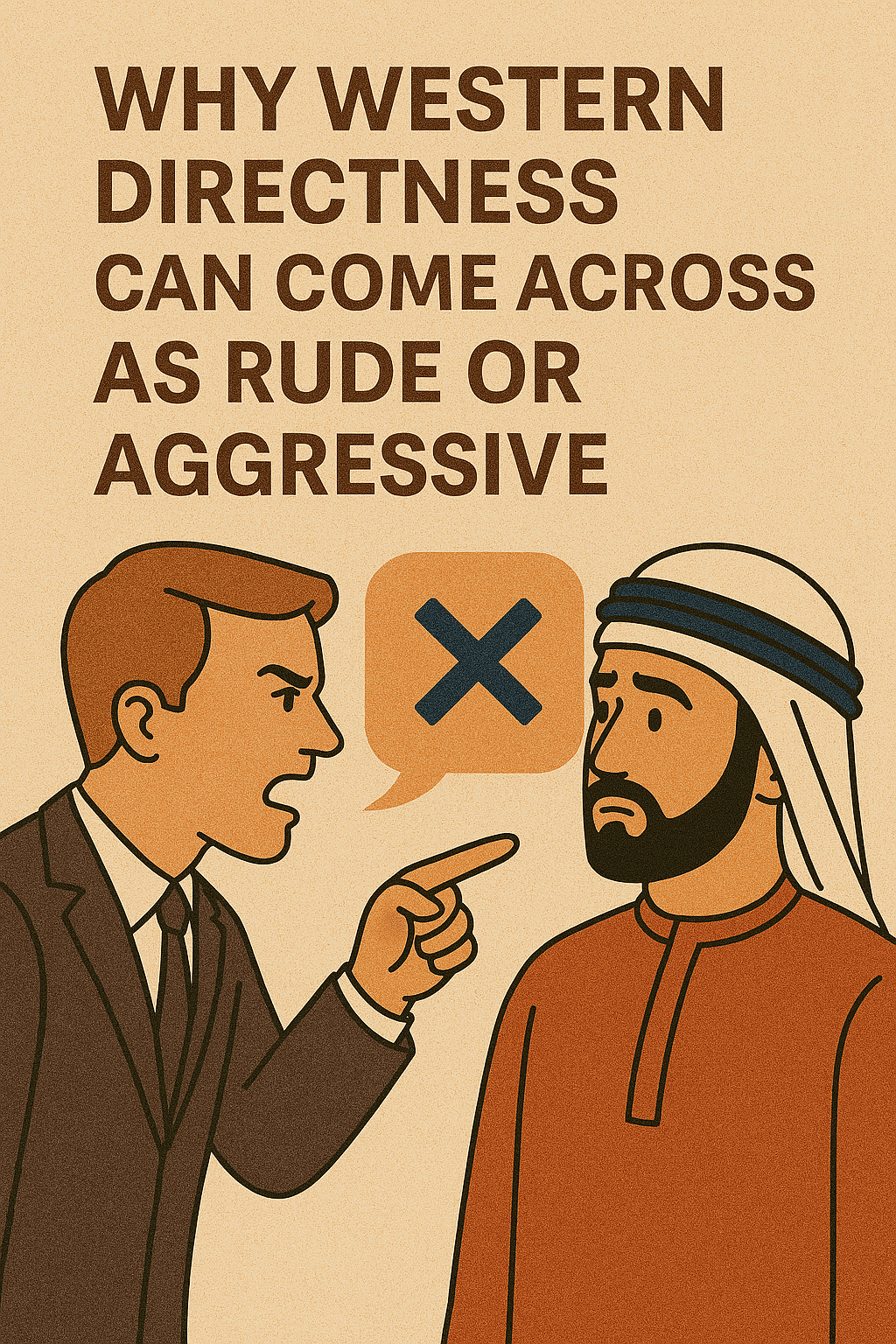
I still remember the look on my uncle’s face when he met my American friend, David, for the first time. David, being the well-intentioned and direct man he was, greeted my uncle with a firm handshake and immediately asked, “So, what do you do for work?” My uncle, gave a polite smile, and redirected the conversation. Later, he pulled me aside and asked, “Why is your friend interrogating me like a police officer?”
David was confused. To him, asking about work was a way to show interest. But to my uncle, this was an abrupt and intrusive question. It’s like asking someone you just met, “how much do you make per month”? or, “How do you spend your money?” This small moment captures a much deeper cultural difference between Western directness and Middle Eastern indirectness—and why Westerners, despite their best intentions, can sometimes come across as rude or aggressive.
The Cultural Contrast: Direct vs. Indirect Communication
Western culture, particularly in the U.S. and much of Europe, values directness. Clarity, efficiency, and getting to the point are seen as strengths. If a Westerner disagrees with an idea, they’ll often say, “I don’t think that will work.” If they want something, they’ll ask for it plainly. If they don’t like the food, they might say, “This isn’t my favorite.”
In contrast, Middle Eastern cultures prioritize relational harmony. Communication is layered, nuanced, and often indirect. Instead of saying “no” outright, one might say, “Inshallah, we’ll see” (which often means no). Instead of saying, “This is wrong,” one might say, “Perhaps we should consider another way.” The goal is not just clarity but also preserving honor and avoiding unnecessary conflict.
How Directness Can Feel Like Aggression
From a Western perspective, being direct is often seen as being honest. But in Middle Eastern contexts, directness can come across as confrontational, disrespectful, or even hostile. Here’s why:
- Honor and Face – Many Middle Eastern societies operate on an honor-shame framework. A direct criticism, even if well-intended, can feel like a public shaming rather than constructive feedback.
- Relationship Over Task – While Western culture prioritizes efficiency and outcomes, Middle Eastern culture prioritizes relationships. A blunt request or critique can feel transactional rather than personal.
- Indirectness as Politeness – What may seem like “beating around the bush” to a Westerner is actually a way to communicate with grace and respect.
Real-Life Example: The Business Deal That Almost Failed
A Western businessman, Mark, was in the Gulf negotiating a deal. The Arab company’s representatives listened politely and nodded throughout the meeting. At the end, Mark asked, “So, do we have a deal?” Silence filled the room. After a long pause, one of the men said, “This is a very interesting proposal. We should continue discussing it.” Mark, expecting a direct “yes” or “no,” left the meeting frustrated, assuming they were wasting his time.
What Mark didn’t realize was that the silence meant they were uncomfortable with how bluntly he asked for a decision. In their culture, negotiations require relationship-building, patience, and subtle cues. By demanding an immediate answer, he unknowingly pressured them into an awkward situation where they couldn’t say “no” outright without offending him.
How to Navigate This Difference as a Westerner
If you’re a Westerner engaging with Middle Easterners—whether in missions, business, or friendships—here are some ways to soften your directness and build stronger relationships:
- Prioritize Relationship Before Business – Before diving into facts and requests, take time for personal conversation. Ask about family, life, and health. This builds trust.
- Soften Your Requests – Instead of “I need this by Friday,” try “Do you think it would be possible to have this by Friday?”
- Read Between the Lines – If someone says, “Inshallah” or “That will be difficult,” they might be saying no. Learn to listen for what’s not being said.
- Avoid Public Confrontation – If you need to correct or disagree with someone, do it privately and gently. Public criticism can cause unnecessary embarrassment.
- Use Stories and Examples – Instead of stating facts bluntly, use stories or analogies to make a point in a way that feels more organic and less confrontational.
Conclusion: Directness Isn’t Wrong, Just Different
Being direct isn’t inherently bad, and neither is being indirect. They’re simply different ways of communicating shaped by cultural values. If you’re a Westerner working or ministering in the Middle East, adjusting your communication style can open doors, deepen relationships, and ultimately make your message more effective.
David, my American friend, eventually learned to ease into conversations rather than jump straight to facts. And my uncle? He came to appreciate David’s sincerity once he understood that his questions were not meant to be rude, just culturally different.
The key is learning to adapt, not just so we don’t offend, but so we can truly connect.
 The Basin and Towel