
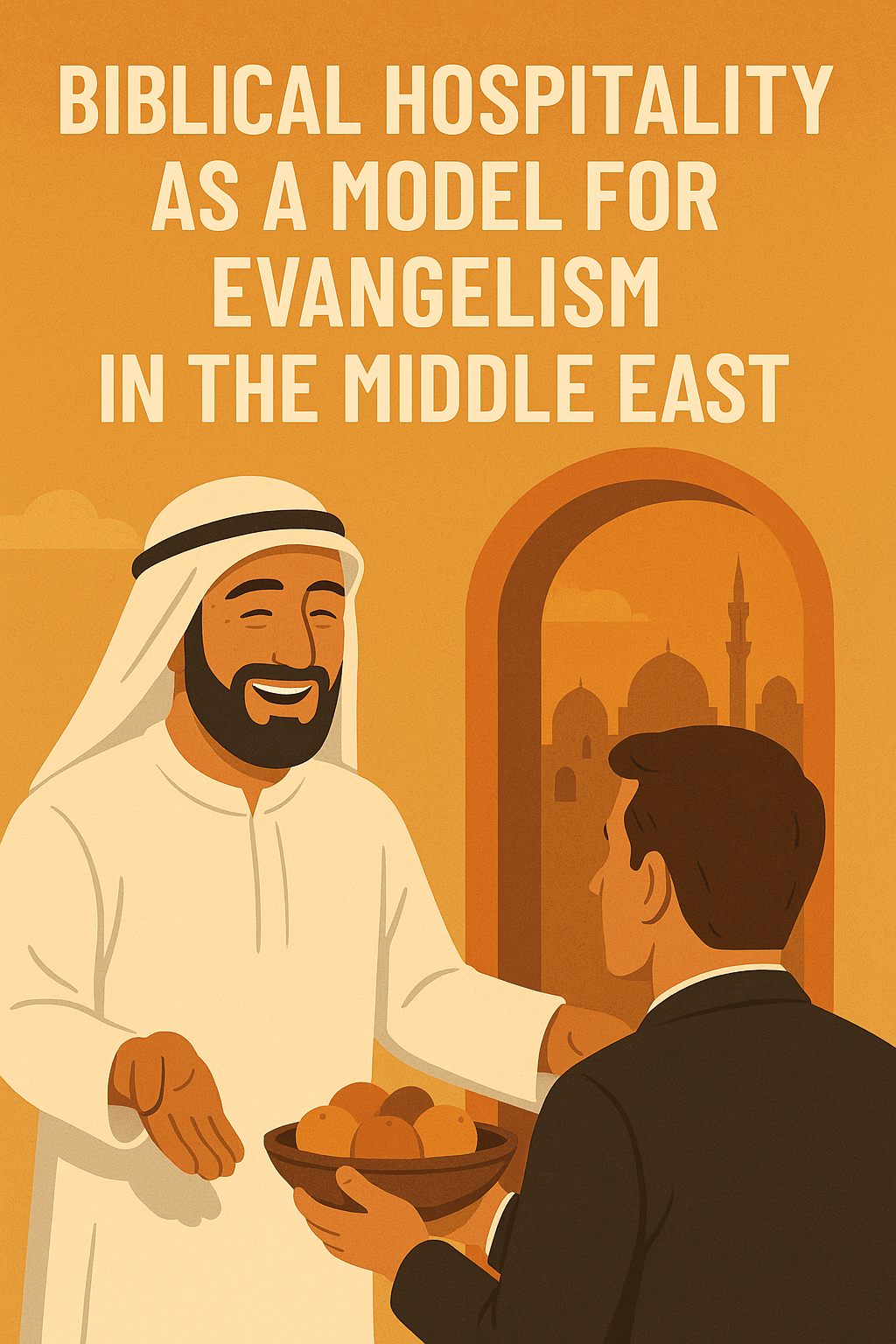
“Be the most generous as a host and the most resolute as a fighter.”
— Ancient Bedouin proverb
It was the middle of summer when a weary traveler approached a Bedouin tent. He had no name, no tribe, and no visible means to repay hospitality. Yet the host did not hesitate. The flap of the tent opened wide, and within minutes, dates, laban, coffee, and bread were set before the man. Why? Because to the Arab, hospitality is not an act of kindness. It is an act of honor. It is warfare against shame.
In the Middle East, hospitality is not about niceties or curated charcuterie boards. It is identity. It is legacy. And, for the follower of Jesus, it is evangelism.
Why Hospitality is the Secret Weapon of Middle Eastern Evangelism
In Western missional paradigms, evangelism often centers on argumentation, outreach events, or scripted presentations. These have their place. But they rarely translate effectively in Arab cultures, where truth is not just taught—it is embodied in relationships, tested over meals, and witnessed in community.
The most effective evangelism in the Middle East begins not with a sermon, but with a seat at the table.
Here’s why:
1. Honor-Based Culture Requires Honor-Based Witness
In shame-honor societies like those in the MENA region, evangelism that feels transactional or confrontational is not only ineffective—it’s offensive. To invite someone into your home, serve them food, and listen without rushing to correct them is to honor them. And in doing so, you reflect the character of Christ, who honored even the tax collector and the Pharisee with His presence.
Jesus didn’t lecture Zacchaeus in the street—He invited Himself to dinner. That’s no small detail. In doing so, He gave dignity to a man the community had already condemned. “Today, salvation has come to this house,” He declared—not the synagogue, not the street corner. The house.
2. Hospitality Opens the Heart Before the Mind
In Arab culture, trust precedes truth. No one cares what you believe until they trust you. And trust is not built in coffee meetings or theological debates—it’s built when you linger over tea, remember their children’s names, and let them serve you as much as you serve them.
Many missionaries miss this. They think urgency means immediacy. But Jesus was never in a hurry, and neither should we be. Evangelism in the Middle East is more like slow-cooked lamb than fast food theology. It takes presence. It takes patience. It takes plates shared across difference.
3. The Table Dismantles Barriers
One of the greatest fears Muslims have when encountering the gospel is that accepting Christ means betraying their family, their culture, even their identity. But when the table is used as a place of honor, respect, and cultural affirmation, the gospel is no longer a foreign invader—it becomes a familiar guest.
You are not asking someone to reject their Arabness. You’re showing them that Jesus is more Arab than they think. After all, Christ Himself sat under Middle Eastern stars, broke bread with His hands, spoke in parables like a village elder, and wept like an Arab father at a funeral.
Biblical Hospitality is Evangelism
Let’s stop seeing hospitality as a soft virtue and start seeing it as a missional strategy. In Scripture, hospitality is deeply theological:
- Abraham entertained strangers and encountered angels (Gen. 18).
- The early church met from house to house, breaking bread and sharing faith (Acts 2:46–47).
- Paul exhorted believers to practice hospitality as an essential spiritual gift (Rom. 12:13).
- And Jesus? He fed multitudes, dined with sinners, and made the Last Supper the central ritual of remembrance.
To open your home is to open a door to the Kingdom.
Practical Ways to Practice Evangelistic Hospitality in the Middle East
- Make time for lingering. Meals are not rushed. Evangelism starts when the plates are cleared and the tea is poured.
- Invite, but don’t interrogate. Ask questions about their story. Honor their journey. They’re more open than you think.
- Learn the rhythms of Arab etiquette. From how you serve coffee to where you sit, everything communicates respect.
- Share stories, not sermons. Arabs are a storytelling people. Frame your faith through narrative, not bullet points.
- Let them give to you. Arabs find dignity in reciprocation. Let them cook for you, pay the bill, or bless your home. This builds relationship.
Evangelism Begins with a Meal, Not a Message
Hospitality is not the prelude to evangelism—it is evangelism. It is how Jesus lived. It is how the early church grew. And in the Middle East today, it is still the most powerful, subversive, and Christlike way to reach the lost.
So set your table. Brew the coffee. Open your door.
Because in this part of the world, the gospel often enters not through the pulpit—but through the plate.
“Do not neglect to show hospitality to strangers, for by this some have entertained angels without knowing it.”
— Hebrews 13:2
 The Basin and Towel