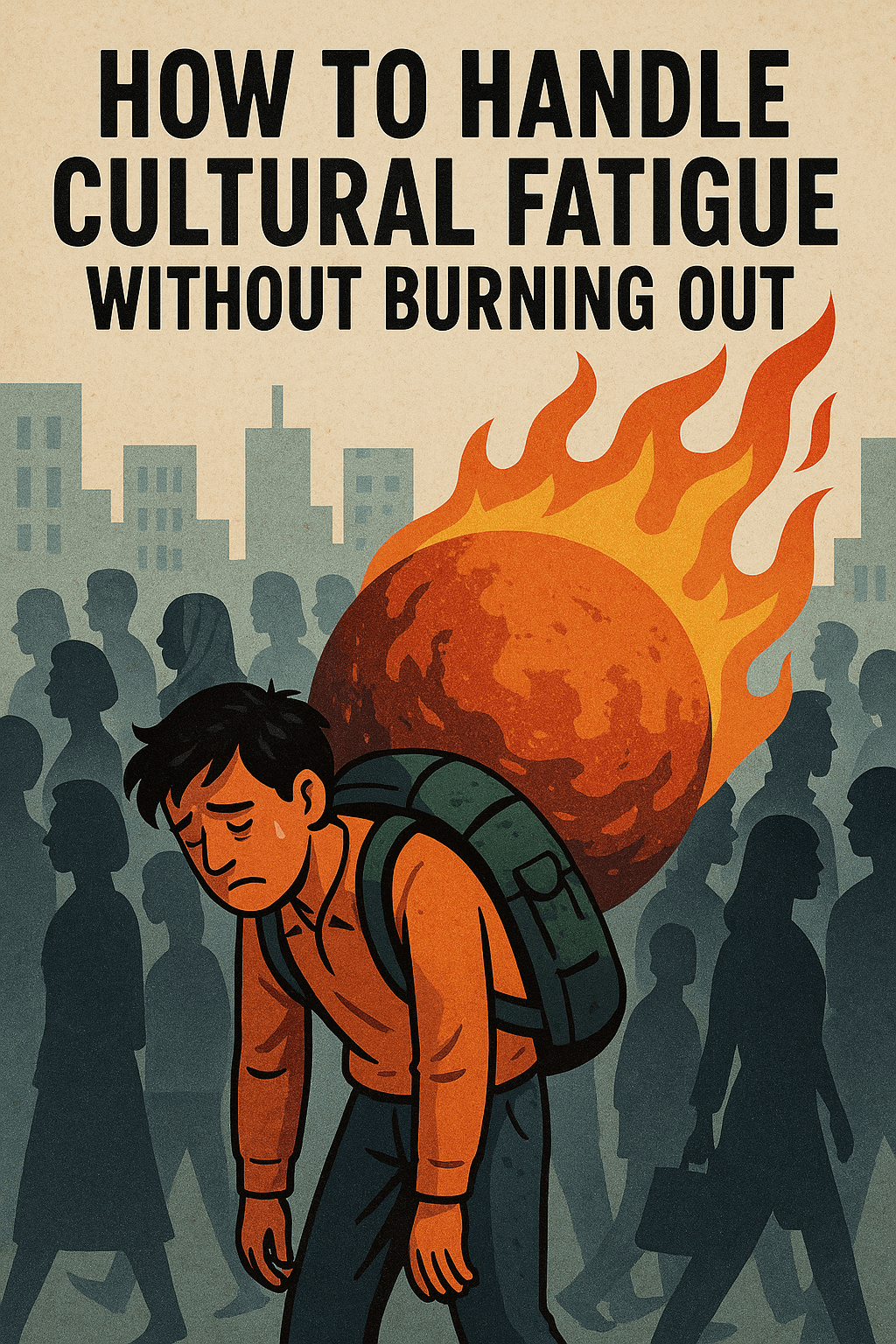
There’s a moment—usually after the honeymoon phase of cross-cultural ministry fades—when you realize this life is not just different. It’s exhausting.
You’re not just learning a new language or navigating unfamiliar foods. You’re carrying invisible weights: social codes you can’t quite crack, spiritual dynamics that seem subtle but powerful, and an emotional fatigue that doesn’t announce itself until it quietly drains your joy.
This is cultural fatigue.
Not because you’re weak. But because you care.
The Silent Strain of Cross-Cultural Obedience
In our context, many Muslims live what I call a split life. Publicly, there’s performance—rituals, expressions, appearances—designed to maintain honor, harmony, and belonging. Privately, there’s often a different world: questions, contradictions, even quiet rebellion or pain.
It’s not hypocrisy. It’s survival.
But when you come from a background where personal integrity is expressed through transparency, this split can feel deceptive. You may not understand why someone warmly invites you into their home one day, and then won’t return your call the next. Or why a neighbor who was deeply moved by a spiritual conversation last week now avoids eye contact in public.
Welcome to the landscape of the seen and the unseen.
Many give up here. Not because they lack calling. But because they lack recalibration.
The Bakery, the Prayer Rug, and the Couch
Let me tell you about Karim.
He owns a corner bakery. Always smiling, always quoting lines from the Qur’an in conversation. His bakery walls are lined with beautiful Arabic calligraphy and he rolls out his prayer mat like clockwork five times a day. To the outside world, Karim is a model Muslim.
But once, in the quiet of his home—just he and I over cardamom coffee—Karim leaned in and asked me, “Do you think God hears people like me?”
There it was. The public Islam and the private Islam. A gap between performance and longing.
If I had judged him by his public face, I’d have written him off as unreachable. But it was in the safety of friendship, in the quiet place where pressure dropped, that truth began to stir.
What does that have to do with your cultural fatigue?
Everything.
Because if you don’t understand this public-private dynamic, you’ll exhaust yourself chasing results that only show up in the private space. You’ll misread silence as rejection. You’ll feel like you’re doing it all wrong when in fact—you’re just in the waiting room of the unseen.
5 Ways to Carry Cultural Fatigue Without Collapse
1. Stop Measuring with Western Metrics
Fruit often grows underground here. You won’t see it immediately, and sometimes not at all. That doesn’t mean it’s not growing. Learn to measure faithfulness, not outcomes.
2. Make Peace With the “Mask”
Just because someone behaves one way in public and another in private doesn’t mean they’re fake. It may be the only way they know to live. Don’t shame them. Learn the rhythm. It’s not deception—it’s a dance.
3. Create Safe Spaces, Not Just Programs
Real transformation in this region happens in spaces of trust, not just in public outreach. If you’re only investing in group settings, you may miss the gold that surfaces in whispered, one-on-one conversations.
4. Protect Your Inner World
You can’t keep pouring out if your private walk with God is dry. Practice your own private devotion fiercely. This region needs more than workers—it needs wells.
5. Laugh More. Seriously.
Cultural fatigue is often heavier because we forget to laugh. The humor here is rich, clever, and healing. Let joy in. It’s not unspiritual—it’s oxygen.
Let the Dust Settle
Every follower of Jesus in this region will have dust on their feet. That’s the nature of the road we walk. But don’t mistake dust for defeat.
Jesus himself got tired. He wept. He withdrew. Not because He was quitting—but because He understood rhythm.
Let the dust settle. Don’t quit the road.
Burnout is not inevitable. But recalibration is non-negotiable.
 The Basin and Towel