
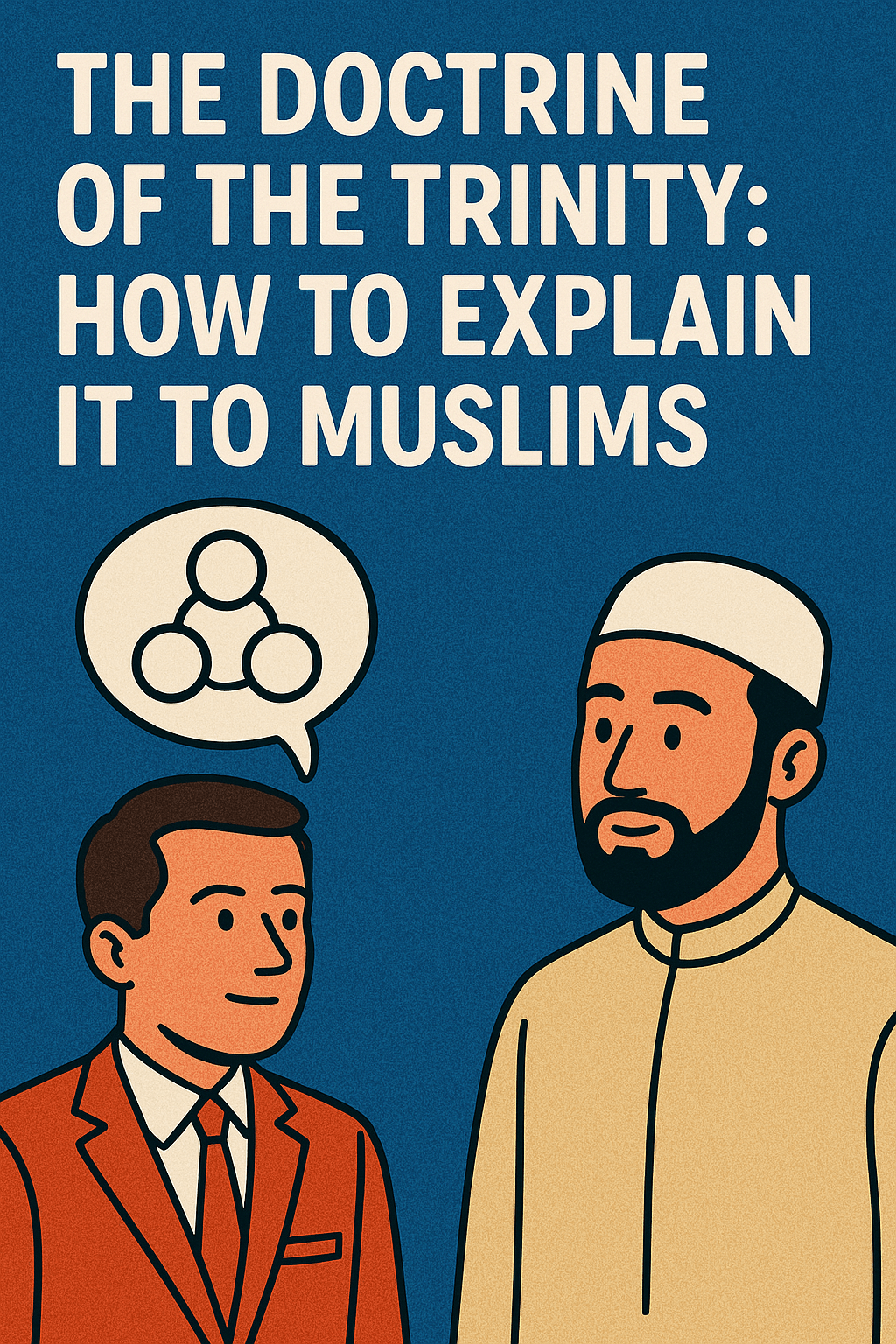
In the remote hills of Lebanon, I once sat with a sheikh under the moonlight, sipping qahwa from tiny, handleless cups. He posed the question I had heard a hundred times, yet each time it carries the same weight: “How can God be three and still be one? You say you are not a mushrik (polytheist), but this sounds like shirk to me.”
I smiled and gently turned the question on him: “Is the fire in your lamp three when it lights three corners of the room?”
He blinked, sat back, and said, “Go on.”
I asked him, where are you originally from? “Aleppo”, he responded proudly. Well, can I say that you are the “son of Aleppo”? (this is often an Arabic expression saying the person is from there). He responded “yes of course”. I explained, well, in the same way, Jesus is the son of God, he came from him and is from his essence.
That’s how we begin. Not with arguments. But with images. Stories. Shared concepts. Let me walk you through how I, as an Arab missiologist and theologian, trained in both scripture and culture, explain the Trinity to Muslims with clarity, honor, and love.
I. Start with Tawhid—Not Trinity
Before we explain the Trinity, we must affirm what Muslims already believe: that God is utterly One (Tawhid), majestic, beyond comprehension. The Qur’an repeats, “Say: He is Allah, the One.” We, too, affirm God’s Oneness. We do not believe in three gods. We must begin by honoring this shared ground, or we will lose the conversation before it starts.
Tip: Avoid using the word “Trinity” upfront. Instead, say something like, “Let me explain how we believe God reveals Himself.” That invites dialogue, not debate.
Another Tip: Please do not use the term “God the Father, God the Son, God the Spirit”. Beside this being theollogically innacurate, it also confuses Muslims. Rather, say, God (Father, son, and Holy Spirit). Thus, you affirm that he is One.
II. Use Honor-Based Analogies, Not Western Logic
Muslims often think in relational, not abstract, categories. So don’t quote Augustine or Aquinas. Tell a story. Use metaphors drawn from light, fire, breath, concepts found in both scripture and creation. I like using the image of the Sun. The sun is Light, fire, and is a planet.
III. Draw from the Qur’an, Carefully
While we do not affirm the Qur’an as revelation, we can reference it to build bridges. The Qur’an denies a Trinity of Allah, Mary, and Jesus, something we also reject. It never truly addresses the biblical Trinity.
Key Point: The Qur’an objects to a misunderstanding of the Trinity, not the doctrine itself.
Use this as an opportunity to clarify: “We agree, God does not have a wife. Jesus is not the son of God through human birth. He is the eternal Word of God made flesh.”
IV. Explain the Trinity Through Divine Love
Ask your Muslim friend: “Can Allah love if He is alone for eternity?”
Then say: “In our understanding, God is eternally relational. The Father loves the Son. The Son loves the Spirit. The Spirit glorifies the Father. Love did not begin when creation began, it has always existed within God.”
Love requires relationship. Unity in diversity is not a weakness. it’s God’s perfection.
V. Anchor in Scripture, Not Systematics
Muslims respect Scripture. Show them the Trinitarian pattern in the Bible without overwhelming them:
- Creation: God speaks (the Word), and the Spirit hovers (Genesis 1).
- Baptism of Jesus: The Father speaks, the Son is baptized, the Spirit descends (Luke 3:21–22).
- Great Commission: “Baptize them in the name (singular) of the Father, Son, and Spirit” (Matthew 28:19).
The Bible doesn’t explain the Trinity in a formula, it reveals it through story, experience, and worship.
VI. Avoid the Common Pitfalls
- Don’t use bad analogies like water/ice/steam—they lead to heresy (modalism).
- Don’t defend the Trinity purely with logic—the goal is not to win an argument but to reveal the beauty of God.
- Don’t get sidetracked by debates on Jesus’ divinity—stick to how God reveals Himself relationally.
VII. Present the Trinity as a Mystery to Be Revered
Muslims value awe and transcendence. Don’t reduce the Trinity to a math problem. Elevate it as divine reality.
“We do not worship a God we fully understand. We worship the One who has made Himself known.”
From Confusion to Worship
The sheikh sat in silence. Then he nodded slowly. “This is different from what I was taught. I see now, it’s not three gods. It’s one God, who loves and reveals Himself.”
He did not come to faith that night. But a seed was planted.
The Trinity is not an obstacle, it is the doorway into understanding that God is love, eternally and perfectly. It is not a contradiction. It is a revelation.
Let us make it plain. Let us make it beautiful. Let us walk the long road of understanding with grace.
 The Basin and Towel