
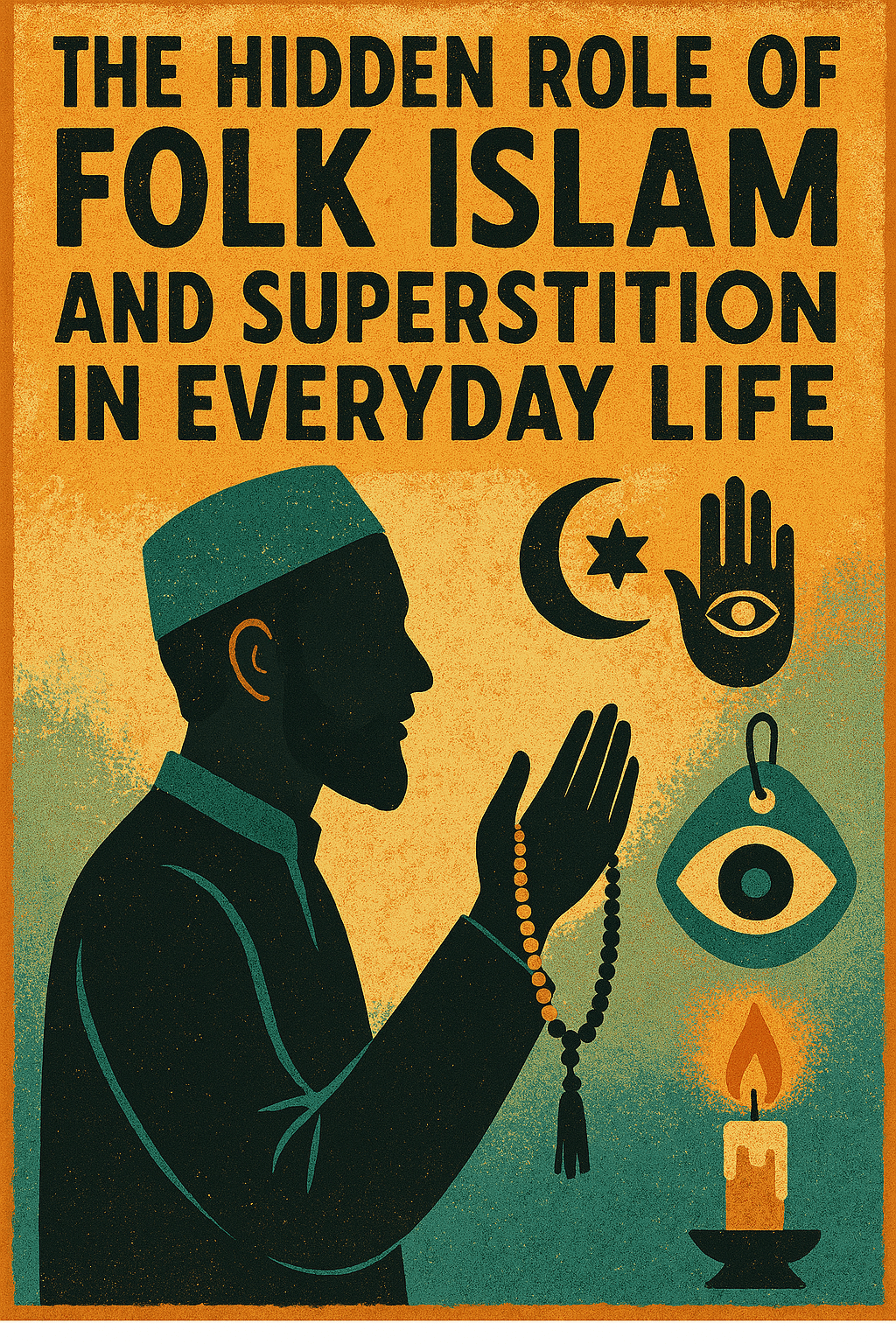
A mother quietly ties a blue bead to her baby’s crib. A taxi driver whispers a verse and taps his steering wheel three times before shifting into gear. A shopkeeper places a tiny black book under his register, not for reading—but for protection.
These actions are not found in formal theology books, nor do they arise from orthodox teachings. Yet they are everywhere—in alleyways, bedrooms, markets, and mosques. They represent a powerful undercurrent in everyday Muslim life: folk Islam, an often-unseen blend of tradition, fear, hope, and survival.
To understand Islam in many parts of the world, one must look beyond the mosque loudspeakers and Friday sermons. Beneath the polished surface of public religiosity lies a deeper layer of private spirituality, stitched together with threads of superstition, cultural practice, and ancestral memory. And it’s here—hidden in the margins—that the true battleground for the soul quietly plays out.
Two Islams: One Face, Two Expressions
Most Muslims would not deny the authority of the Qur’an or the centrality of the five pillars. These are the well-lit hallways of Islam, visible and accepted. But alongside them run darker, narrower alleys—private fears of the evil eye, anxieties about jinn, and rituals that blend local traditions with Islamic vocabulary.
This duality—public orthodoxy and private syncretism—is rarely acknowledged out loud. Yet it shapes daily decisions. What you see at the mosque is only part of the story. What happens behind closed doors is another faith entirely.
A respected teacher once told me, “We recite the Fatiha in the mosque, but we tie knots and burn herbs at home. One is for God. The other is for safety.”
Is it hypocrisy? Not at all. It’s survival.
The Amulet in the Doctor’s Office
In a midsize city clinic, a pediatrician opens a child’s shirt and frowns. The boy has pneumonia. She notices a small cloth tied around his waist. She doesn’t ask about it. She already knows—it’s a ta’wiz, an amulet inscribed with Qur’anic verses and often mixed with tribal symbols or even pre-Islamic talismans.
The parents believe in both medicine and magic. They’ll fill the prescription—but they won’t untie the cloth.
In the doctor’s office, science wins. At home, something older takes the lead.
This is the world of folk Islam—not rebellious or heretical, but deeply felt and deeply ingrained.
Why This Matters
For those seeking to understand Muslim-majority cultures—or work within them—this hidden layer of faith cannot be ignored. You may build trust in public spaces, but unless you understand what governs fear in private, your message may stop at the door.
Islamic theology often says, “God is merciful.” But folk Islam whispers, “God is far—and spirits are near.”
The contrast is subtle, but it makes all the difference in a crisis, a death, or a dream.
Viral Roots: Why It Spreads So Easily
Folk practices offer something formal religion often doesn’t: immediate answers.
- A child is sick? Write a verse, roll it in a tube, and tie it around their neck.
- Business is slow? Hang a specific symbol on the door.
- Feel cursed? Visit a holy man who mixes Islam with mysticism.
It’s spiritual fast food—quick, familiar, comforting. And it’s passed down not through scholars, but through grandmothers and neighbors.
And because it’s rarely challenged or even discussed, it thrives in silence.
Don’t Mistake Appearance for Alignment
It’s tempting to assume that someone who fasts in Ramadan and attends the mosque has a purely orthodox worldview. But the real influences are often older than Islam and deeper than doctrine.
In many households, superstition is not a contradiction to faith—it is faith. Not because people reject formal religion, but because they were raised to live in both worlds.
So What Can Be Done?
- Listen more than you teach. People will reveal their deeper fears if they trust you won’t shame them.
- Ask about dreams. In many contexts, dreams are considered divine or demonic communication. They reveal spiritual hunger.
- Pay attention to symbols. Jewelry, markings, even colors can reveal hidden beliefs.
- Don’t confront—interpret. Instead of condemning an amulet, ask what it means to them. You may find a door to deeper conversation.
A Final Word
Real change doesn’t come by sweeping away superstition with theological brooms. It comes by offering a stronger story—one where God is not only holy, but near. Not only powerful, but personal. Not only to be worshipped on Fridays, but to be trusted on sleepless nights.
Folk Islam thrives in the absence of intimacy with God.
Fill that space.
And you may find that what was hidden starts coming to the surface—not with shame, but with hope.
 The Basin and Towel