“Two men set out to dig a well. One found water. The other found salt.”
— Bedouin proverb
In the endless sands of the Arabian desert, water means life. To dig a well is no small endeavor. It’s a question of survival. Two men may dig in similar soil with similar tools, but only one may find sweet, living water. The other may tap into something that looks like water, but upon tasting it, he discovers it brings no life, only thirst, confusion, and ultimately death.
This proverb captures the heart of the theological divergence between Islam and Christianity. At a distance, the two may appear alike: both speak of one God, both honor prophets, both value scripture, prayer, and submission. But when you taste what lies beneath and when you reach for the source of life, it becomes clear: one is a well of salt, the other a spring of living water.
1. Who Is God? The Nature of the Divine
Islam’s core creed, the Shahada, begins: “There is no god but Allah.”
Christianity’s ancient confession declares: “Jesus is Lord.”
This is not a mere difference in vocabulary, it is a seismic theological divide.
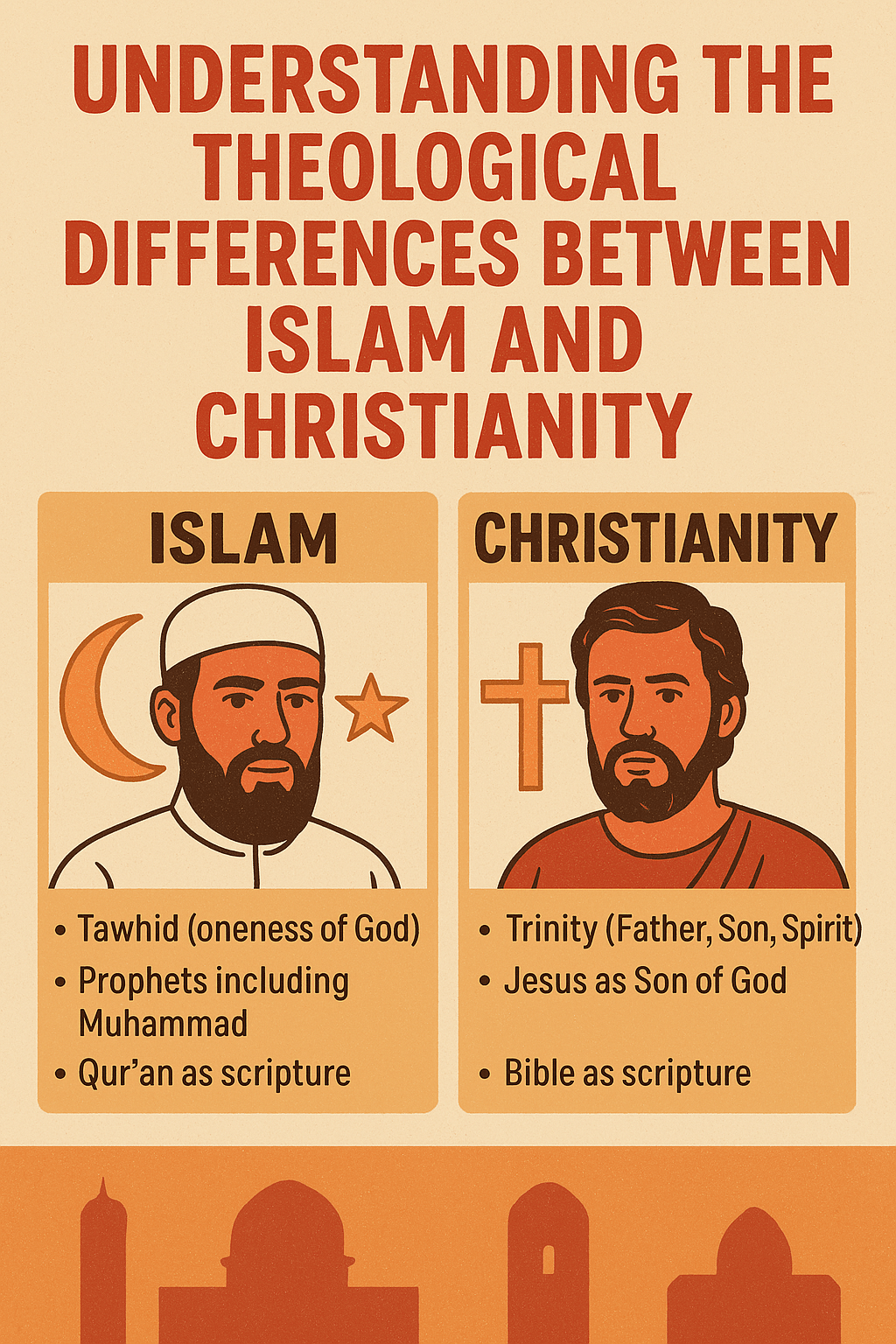
Islam: Absolute Oneness (Tawhid)
Allah is one, utterly singular, indivisible, and transcendent beyond comprehension. To associate anything or anyone with Him (shirk) is the gravest sin in Islam. God is a master. Humans are His servants. Relationship is one of distance, not nearness.
Christianity: Triune Love (Trinity)
The God of the Bible is one in essence, yet three in person—Father, Son, and Holy Spirit. This is not mathematical contradiction; it is relational completeness. God is love, not just loving. His very nature is relational. From eternity, He exists in loving communion. Through Christ, He draws us into that communion—not as slaves, but as sons and daughters.
The difference?
Islam begins with power and distance;
Christianity begins with love and nearness.
2. Who Is Jesus? The Word Made Flesh
To Muslims, Jesus (‘Isa) is a revered prophet who was born of a virgin, sinless, even the Messiah. But he is not divine. He did not die on the cross. He certainly did not rise again.
To Christians, Jesus is God in the flesh, the eternal Word made man. He is not just a messenger. He is the Message.
“In the beginning was the Word, and the Word was with God, and the Word was God… and the Word became flesh and dwelt among us.” (John 1:1,14)
This is incomprehensible and even blasphemous to a Muslim. That God would stoop so low—to suffer, to be humiliated, to die—it violates Islamic notions of divine majesty.
But herein lies the gospel: God humbled Himself to lift us up.
This is not weakness—it is the power of sacrificial love.
3. What Is Salvation? Mercy or Redemption?
In Islam, salvation is attained through submission, obedience, and the mercy of Allah. Good deeds are weighed against bad. No assurance is given—only hope that Allah will be merciful in the end.
In Christianity, salvation is a gift, not a gamble.
It is not earned, but received by grace through faith (Ephesians 2:8–9). The Christian is not hoping to be forgiven—he is already forgiven in Christ, who bore the wrath, paid the price, and rose victorious.
“It is finished,” Jesus declared from the cross—not “try harder.”
This changes everything. The Muslim obeys in fear, hoping to be accepted.
The Christian obeys in joy, knowing he already is.
4. What Is Scripture? Word Sent or Word Incarnate?
Muslims believe the Qur’an is the uncreated, literal word of Allah, dictated to Muhammad. It is sacred because of its Arabic form, its untouched preservation, and its linguistic beauty.
Christians believe the Bible is inspired by God through human authors, telling one unified story. But its climax is not a book—it is a Person: Jesus, the Word of God made flesh.
The Bible points not to itself, but to Him.
5. What Is the End? Hope in Paradise or in the Presence?
Islam’s paradise is a garden—full of sensual pleasure, reward, and rest. But Allah is distant, not the center.
Christianity’s heaven is not just a place—it is a Person.
“This is eternal life: that they know You, the only true God, and Jesus Christ whom You have sent.” (John 17:3)
The goal is not just paradise, but union with God. The reward is God Himself.
Why This Matters
If you are a Westerner trying to understand your Muslim neighbor, know this: their reverence for God is real. Their devotion is deep. But they are drinking from a well that does not satisfy.
If you are a believer working in the Arab world, do not reduce Christianity to moral improvement or a better version of Islam. This is not about better rules—it is about a different God.
One is Master. The other is Father.
Two Wells: A Theological Comparison of Islam and Christianity
| Category | Islam | Christianity |
| Nature of God | Tawhid: Absolute oneness. God is singular, transcendent, unknowable. | Trinity: One God in three persons—Father, Son, Holy Spirit. Relational. |
| Name of God | Allah (not a personal name; title meaning “The God”). | YHWH / Abba (personal, covenantal, relational God). |
| View of Jesus | Prophet, Messiah, virgin-born, not crucified, not divine. | Son of God, fully divine and fully human, crucified and risen Lord. |
| Revelation | Qur’an: Direct, uncreated, Arabic text from heaven. | Bible: God-breathed, written through human authors over centuries. |
| Word of God | The Qur’an is the literal Word of God. | Jesus is the Word of God incarnate (John 1:1). Scripture points to Him. |
| Sin | A mistake, forgetfulness. Human nature is weak but not fallen. | A deep rupture in relationship. All have sinned; nature is fallen (Rom. 3:23). |
| Salvation | Earned through good deeds, prayers, fasting, and Allah’s mercy. | By grace through faith in Christ alone—not of works (Eph. 2:8–9). |
| Role of Jesus in Salvation | Denied. Salvation is through submission and obedience. | Central. Jesus is the sacrifice and mediator who redeems humanity. |
| Assurance of Salvation | No guarantee; depends on Allah’s mercy. | Full assurance through Christ’s finished work on the cross. |
| God’s Justice and Mercy | Mercy overrides justice, often arbitrarily. | Justice and mercy meet at the cross—God is both just and justifier (Rom. 3:26). |
| Goal of Faith | Paradise—a place of pleasure and reward. | Eternal union with God; knowing Him intimately (John 17:3). |
| Relationship with God | Master–servant. Fear-based obedience. | Father–child. Love-based obedience. |
| Holy Spirit | Not a person; considered the angel Gabriel. | Third Person of the Trinity. Indwells, empowers, and leads believers. |
| Crucifixion | Denied. A substitute or illusion. | Historical and essential to salvation. Jesus died and rose again. |
| Resurrection | Denied. | Foundation of the Christian faith (1 Cor. 15:17). |
| Mission | Spread Islam; bring others to submit to Allah. | Make disciples of all nations through the gospel of Jesus Christ. |
A Final Word
In the desert, water is everything.
Two wells. One brings life. The other leaves you thirsty.
The message of the gospel is not that we must reach up to God. It is that God has come down to us—in Jesus.
Not just a prophet. Not just a teacher.
Living Water. Bread of Life. The Door. The Way. The Truth. The Life.
May we be bold enough to proclaim it with clarity, humility, and love.
Dig deep. Find the true well.
 The Basin and Towel