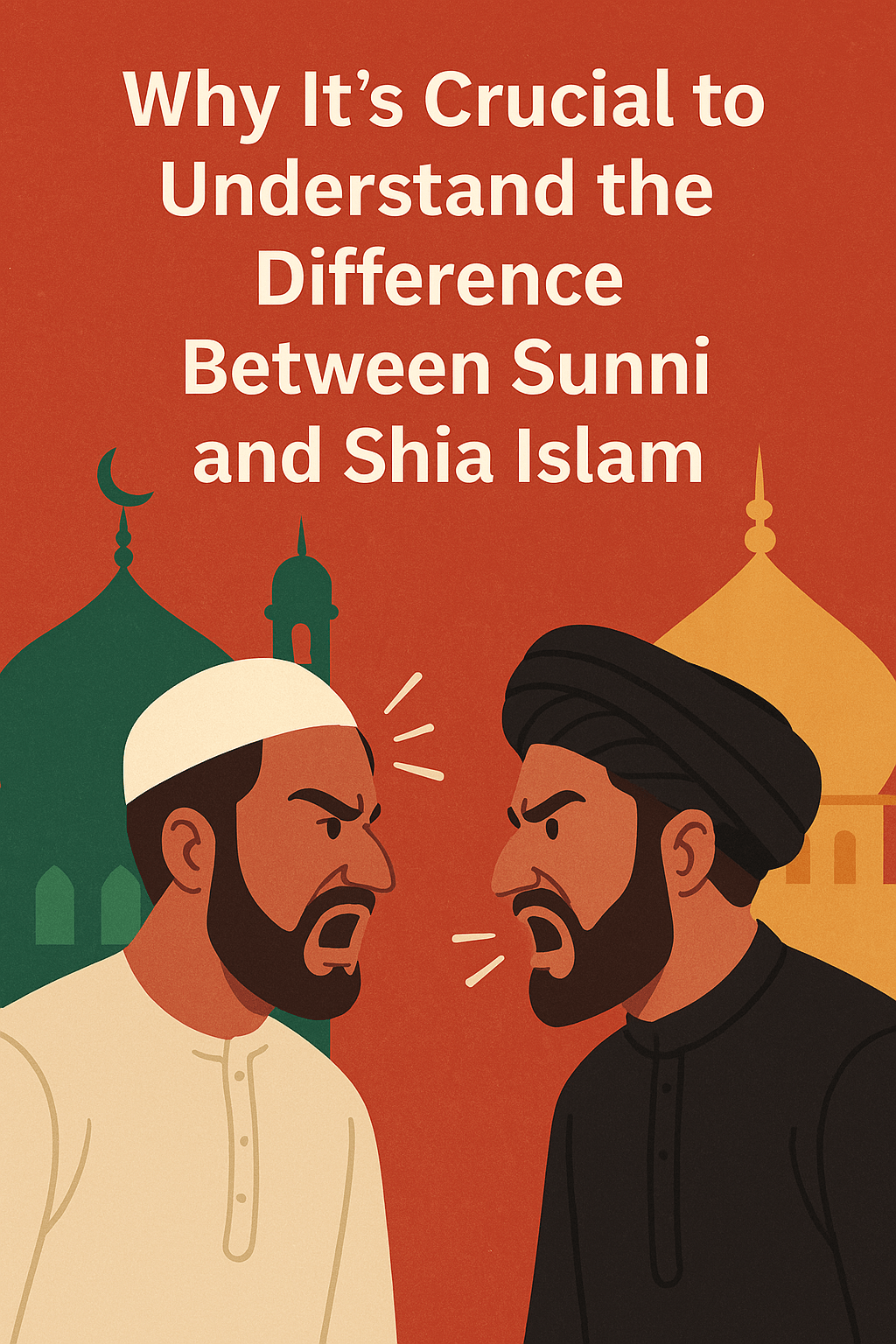
“Two men. One God. One Book. Two very different Fridays.”
I sat in a café in southern Iraq, just after Friday prayers. The streets had been emptied moments earlier, then filled again, not with silence but with murmurs—some prayerful, some political. The air was thick, not just with heat, but with meaning.
Across from me sat two friends—Mustafa and Ali—both Muslims, both devout, both born within 10 miles of each other. One was Sunni. The other, Shia.
What happened next taught me more about Islam than any textbook ever could.
Not Just a Theological Debate
Let’s be clear: the Sunni-Shia distinction isn’t just a doctrinal wrinkle—it’s a deep current shaping culture, identity, and power dynamics across the Islamic world.
At its core, the division centers around a simple question with complex implications: Who should have led the Muslim community after the Prophet Muhammad’s death?
Sunni Muslims (about 85–90% of the global Muslim population) believe leadership should have gone to Abu Bakr, the Prophet’s close companion. Shia Muslims (about 10–15%) believe it should have gone to Ali, the Prophet’s cousin and son-in-law.
Sounds historical. Maybe even remote. But here’s what most people miss: this difference touches everything.
From how leaders are chosen…
To how prayers are prayed…
To how martyrdom is understood…
To how nations like Iran and Saudi Arabia position themselves geopolitically.
Private Faith vs. Public Identity
Here’s where it gets even more layered.
A Sunni man might privately love the teachings of a Shia scholar—but never admit it in public.
A Shia family might pray like Sunnis when traveling—just to stay safe.
A mosque might display unity on the surface while quietly seeding sectarian suspicion behind closed doors.
This isn’t hypocrisy. It’s survival.
It’s a world where public Islam often differs from private Islam—not because of insincerity, but because of context, history, and risk.
If you mistake one for the other, you will misread the entire landscape.
The Baghdad Taxi Driver Test
Let me give you a field test—what I call The Baghdad Taxi Driver Test.
Sit in the front seat of a taxi in Baghdad and ask the driver, “Are you Muslim?”
He’ll nod, probably smile. Then try this: “Sunni or Shia?”
He might pause. Change the subject. Or give a vague answer like, “Just Muslim.”
But his radio station, prayer times, and even the way he curses under his breath will tell you everything.
The surface rarely tells the full story.
Why It Matters More Than You Think
If you’re working with Muslim communities—whether in policy, education, development, ministry, or just friendship—understanding this divide isn’t optional. It’s essential.
Not because we should take sides.
Not because we want to elevate the split.
But because understanding people deeply is the first step toward loving them well.
Without this insight, efforts at bridge-building can unintentionally reinforce division.
Worse, well-meaning gestures can backfire, especially when public expressions are mistaken for private convictions.
A Better Way Forward
What’s needed is discernment rooted in humility.
The kind that listens more than it speaks.
The kind that knows the difference between a whispered prayer and a public sermon.
The kind that can drink tea with both Mustafa and Ali—and know what not to say.
Final Thought
The next time you hear someone say “Muslims believe…” pause.
Ask: Which Muslims? Where? And under what pressure?
In the nuance is the understanding.
And in the understanding is the path to peace.
 The Basin and Towel