
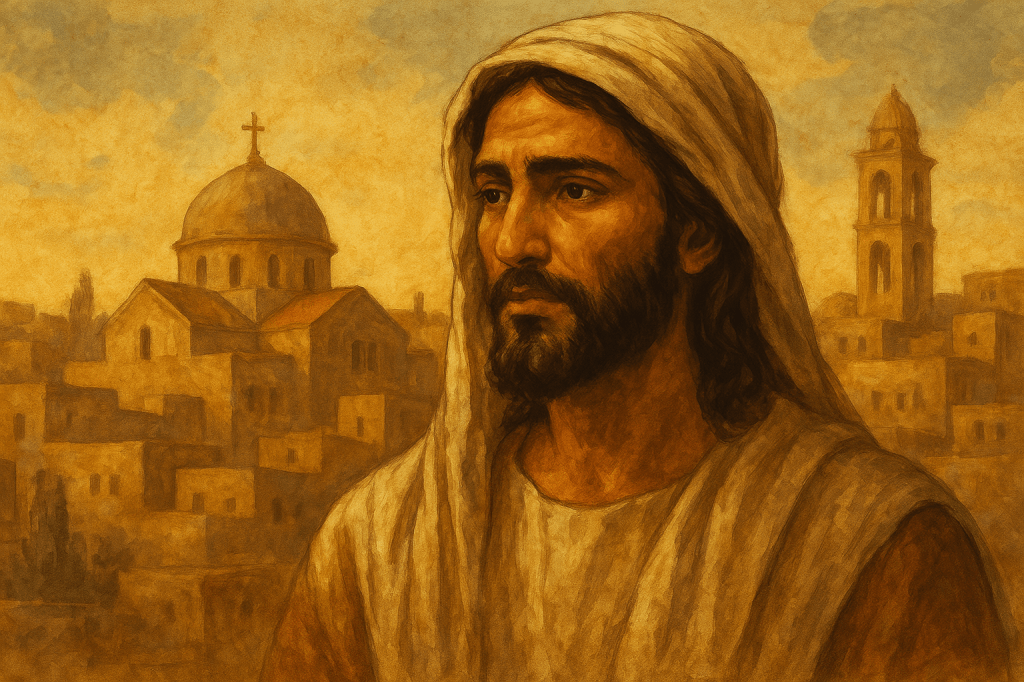
In 1914, a man named George Dow—a Christian from Syria—was denied U.S. citizenship.
Why?
Because he wasn’t white enough.
He worked hard. Practiced his faith. Played by the rules. But America decided he didn’t qualify as a “free white person.” The only way he eventually won in court was because denying him—a Christian—raised too many uncomfortable questions in a so-called Christian nation.
A Middle Eastern Christian had to legally fight to be white enough for the West to accept him.
That’s not just a legal battle. It’s a spiritual x-ray.
It reveals a deeper sickness: Western Christianity has spent centuries whitewashing the gospel, and then exporting it back to the lands where it was born.
When Jesus Was Colonized
The Jesus in stained-glass windows—the pale one with soft features and golden waves—isn’t just bad art.
He’s propaganda.
Rome baptized Him into empire. Europe gave Him aristocratic airs. America made Him a culture warrior. And all along, the gospel stopped looking like good news for the oppressed—and started looking like the face of power.
We didn’t just inherit Jesus.
We inherited a product—wrapped in whiteness, steeped in superiority, and loaded with Western frameworks that don’t speak our language, don’t understand our pain, and don’t fit our context.
The Middle Eastern Church No Longer Recognizes Its Own Faith
I’ve walked into churches across the Arab world where the sermon sounds like Texas, the worship is in English, and the entire experience feels imported. I’ve watched young believers wrestle with the quiet pressure to conform—to Western dress, tone, vocabulary, values.
I’ve sat with those who walked away from church not because they rejected Jesus, but because they couldn’t find Jesus in the church.
We’ve packaged the gospel as a Western brand. And now, in the land of its birth, it feels foreign.
What We’ve Lost
Let’s not sugarcoat it.
We’ve lost our voice.
Instead of preaching with the fire and poetry of our region, we’ve copied Western outlines and academic frameworks. Sermons sound like lectures. Worship feels like a concert. Theology gets translated, not incarnated.
We’ve lost our credibility.
In a region where trust is built on cultural resonance, Westernized churches feel like foreign embassies. To many Muslims, it’s not the gospel we’re preaching—it’s betrayal of heritage, identity, and community.
We’ve lost our power.
You can’t outsource revival. Imported theology may be precise, but it often lacks presence. It’s intellectually sharp but spiritually dull—detached from the story, soil, and suffering of our people.
We’ve lost our momentum.
Western models are heavy and complex. They rely on money, tech, systems, and stagecraft. But the gospel spreads best like wildfire—through homes, stories, relationships, and resilience. What we need is something native, nimble, and unstoppable.
De-Westernization Is Not Rebellion. It’s Resurrection.
We’re not trying to be edgy or rebellious. We’re trying to return to the roots.
To preach Jesus in His own skin—a brown-skinned, Aramaic-speaking man from the Middle East who walked with the poor, challenged empires, and died under occupation.
We’re reclaiming the gospel as something local, indigenous, and holy. Not a product. Not a brand. A Person.
We don’t need to contextualize the gospel. We need to de-contextualize it from the West.
So What Now?
Stop painting Jesus white.
Stop measuring faithfulness by Western benchmarks.
Stop exporting books, programs, and platforms—and start listening to the soil.
Let our churches look like our streets. Let our theology sound like our people. Let our leaders rise from within—not be molded from without.
We don’t need permission to be faithful.
We need space to be authentic.
To Our Western Friends
If you love the Middle East, then love the Middle Eastern Church enough to let her breathe.
Support us—but don’t control us.
Walk with us—but don’t lead us.
Let us preach Jesus in our mother tongue, not yours.
Because He walked our roads.
Spoke our language.
Wept our tears.
The gospel doesn’t need to be imported. It needs to be reclaimed.
This isn’t deconstruction.
This is resurrection.
And it’s time.
 The Basin and Towel